


AI in Logistics: Transforming Global Supply Chains with Intelligence, Automation, and Predictive Power
Global logistics networks are evolving at an unprecedented pace. What was once a linear, predictable system has transformed into a highly dynamic, interconnected ecosystem where even minor disruptions can ripple across continents.
Customer expectations have changed dramatically. Same-day and next-day deliveries are no longer premium offerings—they are becoming standard. Businesses must now provide real-time tracking, accurate delivery windows, and seamless order experiences. At the same time, supply chains face constant disruptions due to weather conditions, geopolitical instability, fluctuating fuel prices, labor shortages, and unexpected demand spikes.
This is where Artificial Intelligence (AI) in logistics is becoming indispensable.
AI is no longer a futuristic concept—it is now the operational backbone of modern logistics networks. It processes massive volumes of structured and unstructured data, predicts delays before they happen, optimizes routes dynamically, and automates repetitive tasks across warehouses and transportation systems.
The pace of AI adoption is accelerating rapidly. Companies that fail to adopt AI risk falling behind competitors who are already leveraging intelligent systems to reduce costs, improve efficiency, and enhance customer satisfaction.
AI connects every node in the logistics ecosystem—suppliers, warehouses, transportation networks, and last-mile delivery—creating a unified, intelligent system that continuously learns and improves.
In this in-depth guide, you will explore:
- What AI in logistics really means
- Key benefits of AI in logistics
- Real-world AI in logistics examples
- Step-by-step implementation strategies
- The future of AI in logistics
This guide is designed for leaders, engineers, and decision-makers who want to understand how AI can transform logistics operations and deliver measurable business value.
What Is AI in Logistics?
Artificial Intelligence in logistics refers to the use of advanced technologies such as machine learning, deep learning, computer vision, natural language processing, and automation systems to enhance the movement, storage, and management of goods.
Unlike traditional logistics systems that rely on predefined rules, AI-driven systems are adaptive. They continuously learn from data and adjust operations in real time.
Core Components of AI in Logistics
AI in logistics is not a single technology—it is a combination of multiple systems working together:
1. Machine Learning Models
These models analyze historical and real-time data to identify patterns and make predictions.
2. Predictive Analytics
Used to forecast demand, delivery times, and potential disruptions.
3. Computer Vision
Enables automated inspection, inventory tracking, and warehouse monitoring.
4. AI Agents
Autonomous systems that can make decisions, trigger actions, and resolve exceptions.
5. Robotics and Automation
Used in warehouses for picking, packing, sorting, and material handling.
From Reactive Systems to Intelligent Networks
Traditional logistics systems are reactive. They respond to problems only after they occur.
AI transforms logistics into a predictive and proactive system.
For example:
- Instead of reacting to delivery delays, AI predicts them in advance
- Instead of manually reallocating inventory, AI does it automatically
- Instead of investigating issues, AI prevents them
Unified Data Layer: The Real Game Changer
One of the biggest challenges in logistics is fragmented data.
AI solves this by integrating data from:
- WMS (Warehouse Management Systems)
- TMS (Transportation Management Systems)
- ERP platforms
- IoT sensors
- GPS tracking systems
- External sources (weather, traffic, port congestion)
This creates a single source of truth for decision-making.
Benefits of AI in Logistics
AI delivers tangible, measurable benefits across all logistics functions.
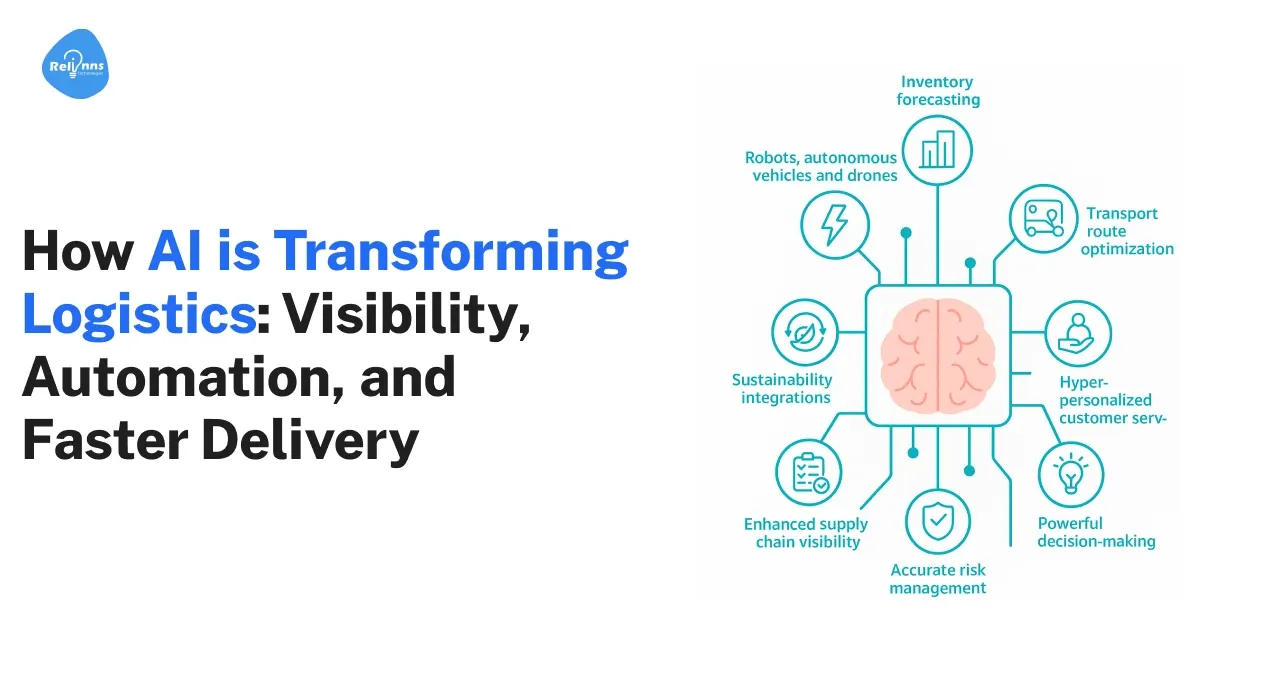
1. Real-Time Visibility and Transparency
Visibility is critical in logistics. Without it, delays, inefficiencies, and errors go unnoticed until it is too late.
AI provides real-time tracking across the entire supply chain.
What Changes:
- End-to-end shipment tracking
- Live updates on delivery status
- Centralized dashboards for monitoring operations
Why It Matters:
- Faster response to disruptions
- Improved customer communication
- Better coordination between teams
2. Intelligent Route Optimization
Route optimization is one of the most impactful applications of AI in logistics.
Traditional routing systems rely on static inputs. AI uses real-time data.
AI Considers:
- Traffic congestion
- Weather conditions
- Road closures
- Fuel efficiency
- Delivery priorities
Results:
- Reduced delivery time
- Lower fuel consumption
- Higher fleet utilization
Companies using AI routing report significant cost savings and improved delivery performance.
3. Warehouse Automation and Smart Fulfillment
Warehouses are becoming increasingly complex due to rising order volumes.
AI-driven automation improves speed, accuracy, and efficiency.
Technologies Used:
- Autonomous Mobile Robots (AMRs)
- Automated Guided Vehicles (AGVs)
- AI-based picking systems
- Smart inventory tracking
Benefits:
- Up to 99% picking accuracy
- Faster order fulfillment
- Reduced labor costs
- Improved worker safety
4. Predictive Demand Forecasting
Demand forecasting directly impacts inventory management.
AI improves forecasting accuracy by analyzing multiple variables.
Data Sources:
- Historical sales data
- Seasonal trends
- Market demand signals
- Customer behavior
Impact:
- Reduced stockouts
- Lower excess inventory
- Better cash flow management
5. Risk Management and Exception Handling
Logistics operations are filled with uncertainties.
AI helps identify and mitigate risks proactively.
Examples:
- Predicting port congestion
- Identifying supplier delays
- Detecting anomalies in shipment data
Benefits:
- Faster issue resolution
- Reduced operational disruptions
- Improved reliability
6. Cost Optimization
AI helps reduce costs across logistics operations.
Areas of Savings:
- Fuel consumption
- Labor costs
- Inventory holding costs
- Operational inefficiencies
Even small improvements at scale result in significant cost savings.
AI in Logistics Examples: Real-World Use Cases
1. DHL and Locus Robotics
DHL implemented AI-powered robotics to improve warehouse operations.
Results:
- 200–300% increase in productivity
- 50% reduction in worker travel
- 99% order accuracy
2. Walmart
Walmart uses AI for demand forecasting and inventory management.
Results:
- 30% reduction in stockouts
- Improved supply chain efficiency
- Reduced inventory waste
3. Amazon
Amazon uses AI across its entire logistics network.
Applications:
- Warehouse automation
- Delivery optimization
- Demand forecasting
Impact:
- Faster deliveries
- Improved customer experience
- Highly efficient operations
4. UPS
UPS uses AI for route optimization.
Results:
- Reduced fuel consumption
- Improved delivery efficiency
- Lower operational costs
How to Implement AI in Logistics
1. Assess Data Readiness
AI requires clean, structured data.
Steps:
- Audit existing systems
- Identify data gaps
- Integrate data sources
2. Identify High-Impact Use Cases
Focus on areas with the highest ROI.
Examples:
- Route optimization
- Demand forecasting
- Warehouse automation
3. Select the Right Tools
Choose AI solutions based on your needs.
4. Run Pilot Projects
Start small and validate results.
5. Scale Gradually
Expand AI across the supply chain.
Future of AI in Logistics
1. Multi-Agent Systems
Autonomous agents will manage logistics operations collaboratively.
2. Digital Twins
Virtual simulations of logistics networks will enable better planning.
3. Autonomous Supply Chains
Fully automated supply chains will become a reality.
4. Hyper-Personalization
Customers will receive customized delivery experiences.
Conclusion
AI in logistics is no longer optional.
It is essential for:
- Efficiency
- Scalability
- Competitiveness
Organizations that adopt AI today will lead tomorrow.
Why Choose Relinns
Relinns provides AI-powered logistics solutions that deliver measurable results:
- 48% fewer delays
- 55% better visibility
- 40% higher accuracy
FAQs
What are the benefits of AI in logistics?
Improved efficiency, visibility, and cost reduction.
Is AI hard to implement?
Not if you start small and scale gradually.
What is the future?
Autonomous, intelligent supply chains
FAQs
What are the benefits of AI in logistics?
Improved efficiency, visibility, and cost reduction.
Is AI hard to implement?
Not if you start small and scale gradually.
What is the future?
Autonomous, intelligent supply chains
FAQs
What are the benefits of AI in logistics?
Improved efficiency, visibility, and cost reduction.
Is AI hard to implement?
Not if you start small and scale gradually.
What is the future?
Autonomous, intelligent supply chains
FAQs
What are the benefits of AI in logistics?
Improved efficiency, visibility, and cost reduction.
Is AI hard to implement?
Not if you start small and scale gradually.
What is the future?
Autonomous, intelligent supply chains
FAQs
What are the benefits of AI in logistics?
Improved efficiency, visibility, and cost reduction.
Is AI hard to implement?
Not if you start small and scale gradually.
What is the future?
Autonomous, intelligent supply chains
FAQs
What are the benefits of AI in logistics?
Improved efficiency, visibility, and cost reduction.
Is AI hard to implement?
Not if you start small and scale gradually.
What is the future?
Autonomous, intelligent supply chains
FAQs
What are the benefits of AI in logistics?
Improved efficiency, visibility, and cost reduction.
Is AI hard to implement?
Not if you start small and scale gradually.
What is the future?
Autonomous, intelligent supply chains
FAQs
What are the benefits of AI in logistics?
Improved efficiency, visibility, and cost reduction.
Is AI hard to implement?
Not if you start small and scale gradually.
What is the future?
Autonomous, intelligent supply chains
FAQs
What are the benefits of AI in logistics?
Improved efficiency, visibility, and cost reduction.
Is AI hard to implement?
Not if you start small and scale gradually.
What is the future?
Autonomous, intelligent supply chains
FAQs
What are the benefits of AI in logistics?
Improved efficiency, visibility, and cost reduction.
Is AI hard to implement?
Not if you start small and scale gradually.
What is the future?
Autonomous, intelligent supply chains
FAQs
What are the benefits of AI in logistics?
Improved efficiency, visibility, and cost reduction.
Is AI hard to implement?
Not if you start small and scale gradually.
What is the future?
Autonomous, intelligent supply chainsFAQs
What are the benefits of AI in logistics?
Improved efficiency, visibility, and cost reduction.
Is AI hard to implement?
Not if you start small and scale gradually.
What is the future?
Autonomous, intelligent supply chainsFAQs
What are the benefits of AI in logistics?
Improved efficiency, visibility, and cost reduction.
Is AI hard to implement?
Not if you start small and scale gradually.
What is the future?
Autonomous, intelligent supply chainsFAQs
What are the benefits of AI in logistics?
Improved efficiency, visibility, and cost reduction.
Is AI hard to implement?
Not if you start small and scale gradually.
What is the future?
Autonomous, intelligent supply chainsFAQs
What are the benefits of AI in logistics?
Improved efficiency, visibility, and cost reduction.
Is AI hard to implement?
Not if you start small and scale gradually.
What is the future?
Autonomous, intelligent supply chainsFAQs
What are the benefits of AI in logistics?
Improved efficiency, visibility, and cost reduction.
Is AI hard to implement?
Not if you start small and scale gradually.
What is the future?
Autonomous, intelligent supply chainsFAQs
What are the benefits of AI in logistics?
Improved efficiency, visibility, and cost reduction.
Is AI hard to implement?
Not if you start small and scale gradually.
What is the future?
Autonomous, intelligent supply chainsFAQs
What are the benefits of AI in logistics?
Improved efficiency, visibility, and cost reduction.
Is AI hard to implement?
Not if you start small and scale gradually.
What is the future?
Autonomous, intelligent supply chainsFAQs
What are the benefits of AI in logistics?
Improved efficiency, visibility, and cost reduction.
Is AI hard to implement?
Not if you start small and scale gradually.
What is the future?
Autonomous, intelligent supply chainsFAQs
What are the benefits of AI in logistics?
Improved efficiency, visibility, and cost reduction.
Is AI hard to implement?
Not if you start small and scale gradually.
What is the future?
Autonomous, intelligent supply chainsFAQs
What are the benefits of AI in logistics?
Improved efficiency, visibility, and cost reduction.
Is AI hard to implement?
Not if you start small and scale gradually.
What is the future?
Autonomous, intelligent supply chainsFAQs
What are the benefits of AI in logistics?
Improved efficiency, visibility, and cost reduction.
Is AI hard to implement?
Not if you start small and scale gradually.
What is the future?
Autonomous, intelligent supply chainsFAQs
What are the benefits of AI in logistics?
Improved efficiency, visibility, and cost reduction.
Is AI hard to implement?
Not if you start small and scale gradually.
What is the future?
Autonomous, intelligent supply chains