The Power of Lifelong Learning in a Changing World
Updated at Jun 18, 2026
4 min to read

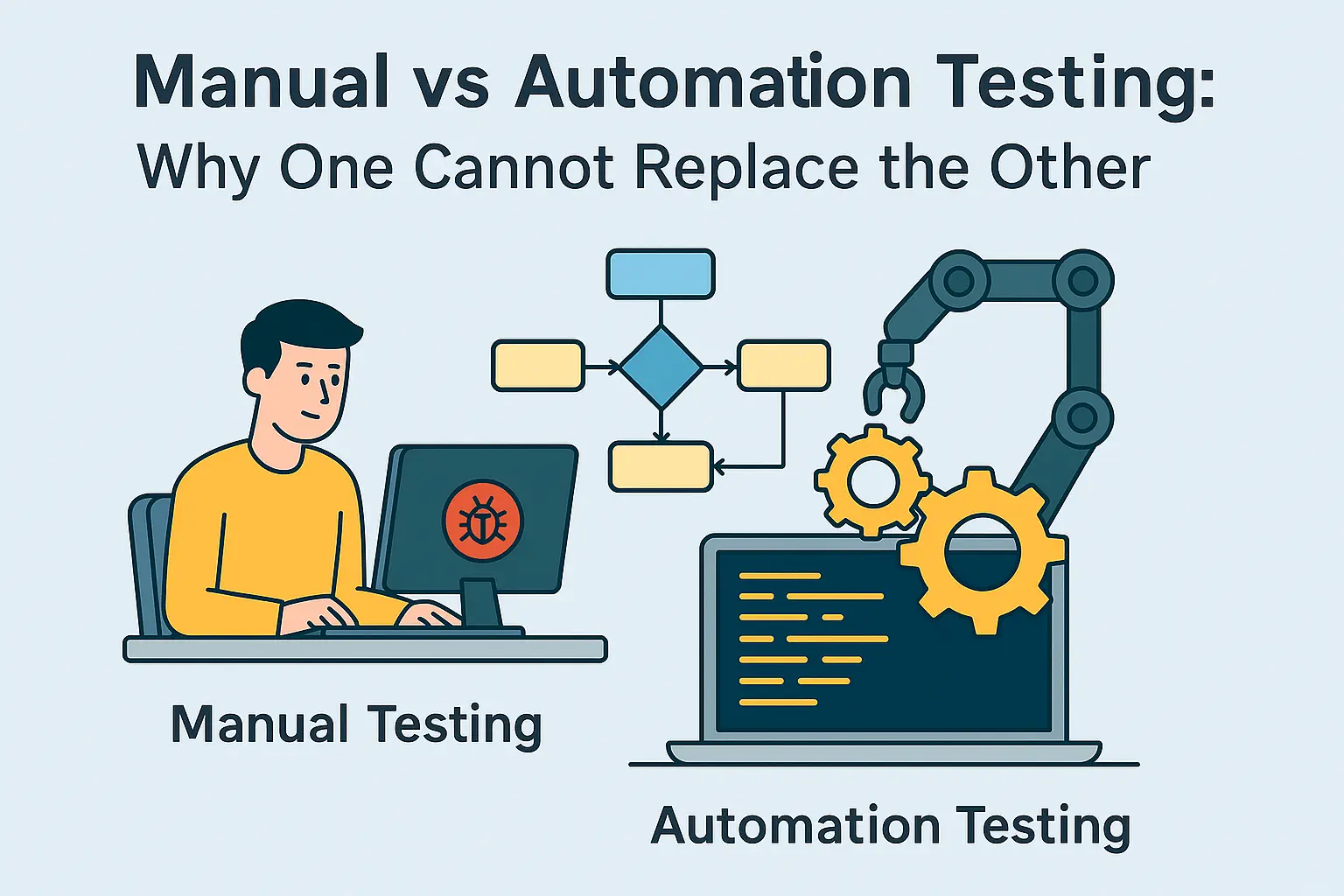
Automation testing has revolutionized how we deliver software, but there's a growing misconception: that it can completely replace manual testing. It can't. Manual testing is the foundation of QA, and without it, automation is aimless. While automation speeds things up, it can't see, feel, or think. In this guide, we break down why both testing methods need each other. Because at the end of the day, Automation ≠ Elimination.
Manual testing is when a human tester checks a software product by using it like a real user. They look at the design, test how it behaves, and try to find things that might break or confuse users. Manual testers use their eyes, judgment, and curiosity to explore the product. This kind of testing is flexible. It adapts to real-world conditions and unexpected behaviors.
For example, while testing a checkout process, a manual tester might notice that a "Continue" button is too close to the "Cancel" button—something that might confuse users or lead to accidental clicks. An automated script wouldn’t flag that.
"Manual testing is not just about finding bugs; it’s about understanding user behavior and aligning the product with real-world needs." — James Bach, software testing expert
Automation testing uses tools and scripts to run predefined tests. These scripts check if the app still works as expected after code changes. It’s fast, repeatable, and great for regression testing. It shines when you need to test the same thing across multiple browsers, devices, or datasets.
Companies like Netflix and Google rely heavily on automation to speed up deployments, especially in continuous integration/continuous delivery (CI/CD) pipelines. But even they use manual testing for UI/UX and exploratory testing.
Manual is like a chef tasting the food. Automation is the machine chopping the vegetables. Both are essential. According to Capgemini’s World Quality Report 2023, 73% of enterprises combine manual and automated testing to meet both speed and quality goals.
Manual testing is perfect for UI/UX testing, exploratory sessions, and one-time flows. It’s flexible and reacts to unknowns in the system.
Automation excels in repeated tasks like regression, load, or API testing. It’s great when speed, consistency, and scale matter. For instance, testing 10,000 login attempts in under a minute is possible only through automation.
In agile teams, manual testers validate new features quickly and thoroughly. They mimic end-user behavior and provide feedback on the overall experience. Once features stabilize, automation testers create scripts to lock in functionality for future regression cycles.
Case Study: At Atlassian, manual testers lead exploratory testing sessions before each major release. These sessions consistently uncover bugs that automated tests miss.
Manual testing leads because no script exists before a feature is understood. It helps define the edge cases and user flows. Automation simply codifies what manual testers have discovered.
In a 2024 survey by PractiTest, 81% of QA professionals said manual testing is essential in defining what to automate.
Imagine launching a new feature, like a "Schedule Pickup" in a delivery app. Manual testers explore it first—checking if the time selector works, if the calendar UI is clear, and if unexpected inputs crash the flow.
Once the feature is stable and user scenarios are defined, automation testers write scripts to cover it. These tests are added to the regression suite to ensure future changes don’t break anything.
Real Example: At Shopify, manual testers explore every new merchant-facing feature for usability, while automation ensures those features continue working across weekly deployments.
Take a payment gateway rollout:
Manual testing acts like a discovery phase. Automation ensures stability.
Manual testing defines the test cases. What should be tested, in what sequence, and under what conditions—these inputs originate from human thought.
Without manual insight, automation is like a GPS without a destination.
Automation is execution. It doesn’t explore. It doesn’t infer or adapt. If a test script isn’t told to look for a visual glitch or misleading tooltip, it won’t catch it.
Consider an e-commerce filter system: a manual tester may discover that filtering by “Under $50” removes all items. A script, if not explicitly built to check this, might pass the test based on backend response code alone.
That’s why manual testing over automation testing isn’t a fallback—it's the foundation.
Tools don’t spot emotional friction. For example, a color-coded error message might technically display correctly—but if red and green aren’t accessible to colorblind users, only a human will notice.
Data: According to the WebAIM survey, 98% of homepages had accessibility issues in 2023—issues often caught only through manual audits.
Testers ask: "Would this make sense to my mom?" or "What if the user has poor internet?" Tools don't ask questions.
Manual testing allows for spontaneous decision-making. A tester might try things no one thought of—like submitting empty forms, clicking disabled buttons, or testing on low-end devices.
In the QA future, creativity will be just as important as speed.
In 2023, a fintech app experienced login failures in 5% of iOS devices. Automation showed all green. Manual testers found the cause: a hidden iOS keyboard was blocking the "Submit" button.
Automation checked server responses. But users couldn’t even tap the button. Manual testers flagged it during exploratory testing. The issue was fixed before going live to 20,000 users.
Quote from QA Lead: "That bug would’ve cost us a 1-star rating. Manual testing saved the release."
Scripts are only as good as their coverage. Anything outside that is ignored. If the UI changes and no one updates the script, false positives or false negatives flood the reports.
Stat: In a GitLab 2023 report, 62% of developers reported flaky or misleading test automation results.
A real user journey is messy. They resize browsers, use dark mode, zoom in, and switch languages. Only human testers catch things like layout breaks or confusing icon placement.
Manual testing helps QAs become product experts. That tribal knowledge gets lost when you rely solely on tools. And without that, testing over manual testing is a risky shortcut.
Automation increases speed. Manual increases depth. When used together, you get better coverage, smarter testing, and more confidence in releases.
Case Study: Microsoft’s QA teams use manual testing during live user simulation and automation for build validation. Bugs found in manual tests have decreased post-release issues by 35%.
A tool might tell you everything passed. A human will tell you if it makes sense. Quality means more than green checkmarks.
The smartest QA teams today balance both worlds—and win.
Conclusion
Manual testing isn't dead. It's the reason automation works at all. Without it, scripts have no foundation, no direction, and no context.
Automation might be the engine — but manual testing is the steering wheel.
Subscribe to Our Newsletter
Get the latest business insights straight into your inbox.
Checkout our related blogs you will love.
Updated at Jun 18, 2026
4 min to read
Updated at Mar 14, 2026
60 min to read
Updated at Aug 22, 2025
14 min to read
Table of Contents